

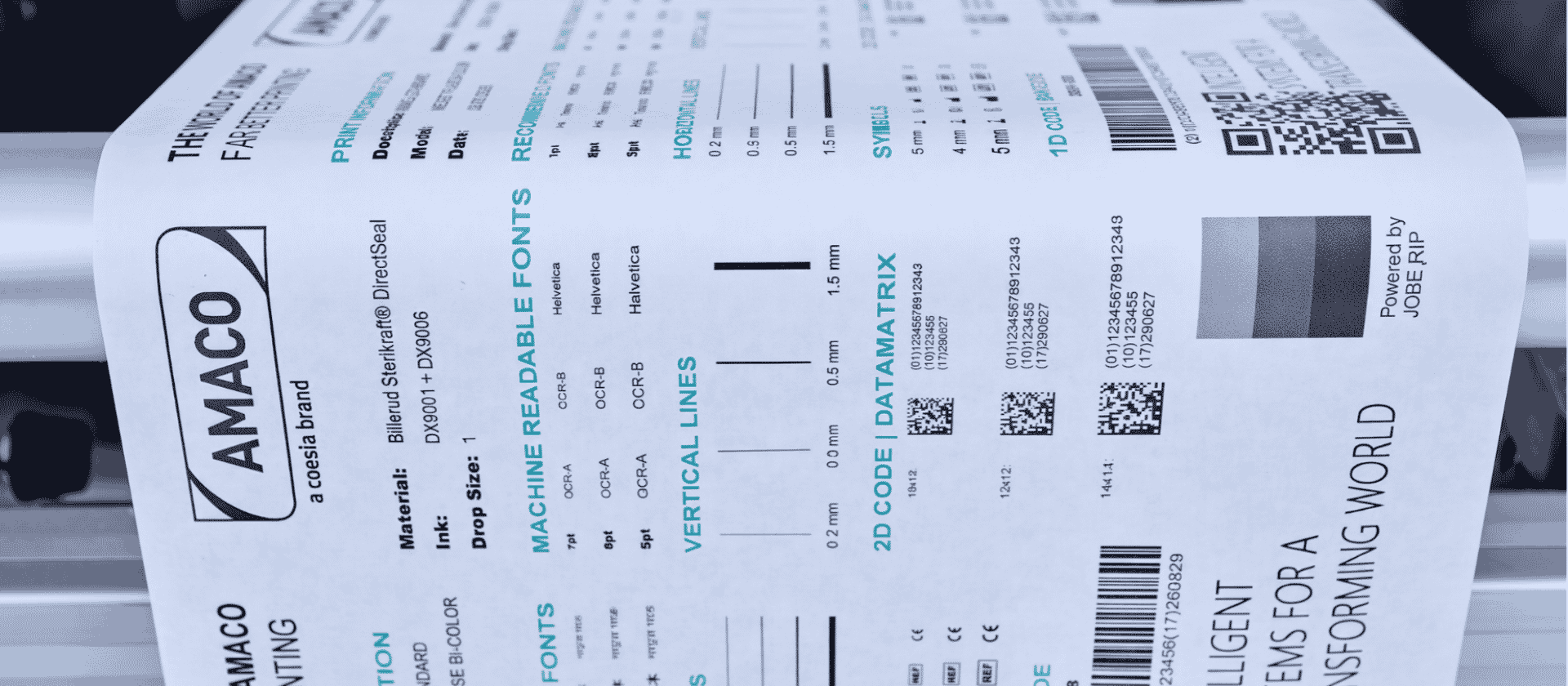
Advancing medical packaging: how AMACO and Billerud connect materials, printing, and compliance
Medical packaging must carry clear, accurate, and traceable information while preserving the integrity of the sterile barrier. As regulatory and operational demands increase, materials and printing technology can no longer be considered separately. Our collaboration with Billerud addresses this challenge by combining medical-grade paper with high-resolution digital inline printing and integrated vision inspection in an approach to safety, compliance, and production efficiency.
Through AMACO’s scientific, data-driven validation of the substrate, ink, and print technology as a complete application, we establish the conditions for strong adhesion, excellent code readability, and reliable variable-data printing. Vision inspection adds a further layer of control, enabling printed artwork and variable content to be checked during production. The result is a more controlled route from application development to implementation, giving medical packaging teams greater confidence in both print performance and process reliability. This directly addresses common customer pain points where non-validated substrates cause poor print adhesion and illegibility—ultimately preventing costly recalls and brand damage.
Building compliance into the packaging process
In medical-device packaging, every UDI, batch number, expiry date, barcode, or GS1 DataMatrix code must be accurate, legible, and connected to the correct package. By integrating Billerud medical paper with our digital inline printing and vision inspection technologies, printing and verification take place within the production process itself. Each code can be checked in real time, reducing the risk of mismatches and strengthening quality assurance at the point where it matters most.
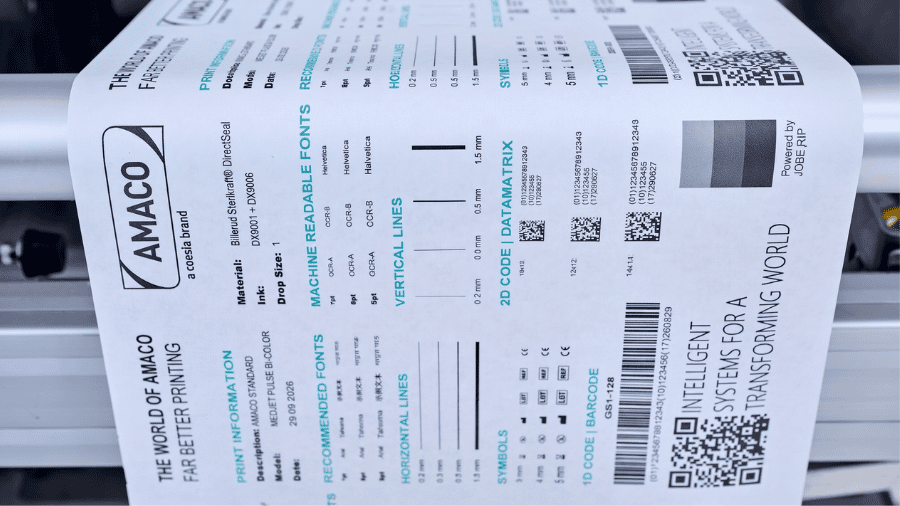
Print performance starts with the right combination
Clear, durable codes depend on more than printing resolution. The substrate, ink, and printing technology must perform as one system. Pre-testing and validating is therefore central to our application-development process with Billerud: its medical paper is evaluated together with our contact-free, high-resolution digital printing technology to define suitable settings before implementation.
This process brings together complementary areas of expertise. Billerud contributes in-depth knowledge of medical packaging materials, while we contribute printing technology, ink development, and application testing methodology. The combination enables us to address adhesion, code readability, and variable-data performance as interconnected requirements instead of isolated technical parameters, and to guide manufacturers from application development through implementation.
This pre-tested combination provides a useful reference for customers’ subsequent validation stages, building confidence when introducing a new printing process or changing packaging substrates. With both companies bringing expertise in medical packaging, our collaboration reflects a shared understanding of the regulatory requirements and quality expectations that underpin and speed up customers validation processes.
From pre-printed inventory to on-demand agility
Inline printing changes where and when packaging information is created. Instead of relying on multiple pre-printed material variants, manufacturers can print complete packaging artwork directly onto the material web during production, including market-specific text, graphics, variable data, barcodes, and GS1 DataMatrix codes. This allows packaging to adapt in real time to changing product, market, and regulatory requirements.
The operational implications extend across the value chain. Greater material standardization reduces inventory complexity and dependence on minimum order quantities, while on-demand production limits obsolete stock and material waste. By removing separate marking and coding steps, inline printing also streamlines production and supports faster time to market, turning packaging flexibility into a practical business advantage.
AMACO’s core expertise lies in the printing as a solution, with the complete artwork printed onto the material web available for inspection by an integrated camera system. Depending on the inspection system and application requirements, checks can cover text, graphics, variable data, barcodes, and GS1 DataMatrix codes. This enables manufacturers to compare printed content against approved artwork and detect printing discrepancies during production, supporting consistent quality and greater control over the packaging process.
Safety extends beyond the printed code
For sterile barrier packaging, accurate information is only part of the requirement. The printing process must also preserve the package’s critical microbial barrier properties in line with ISO 11607. This places equal importance on substrate compatibility, print performance, and ink chemistry. Biodegradable mineral-oil-free inks, near-zero volatile organic compounds, and the absence of hazardous air pollutants contribute to an application designed around both patient safety and more sustainable material choices.
Pre-testing the material and print technology as an integrated application reduces uncertainty before production begins. Once in operation, synchronized printing and vision inspection provide an additional layer of control by verifying coding and traceability within the same production run. Together, these measures create a more robust path to compliant medical packaging.
Complementary expertise, one application approach
The collaboration combines Billerud’s expertise in medical packaging materials with AMACO's capabilities in printing technology and application development. This creates continuity from material selection and testing to implementation and ongoing service, giving manufacturers access to coordinated expertise throughout the project lifecycle. With both companies operating internationally—and AMACO supported by Coesia’s global presence—the same application approach can also be extended across multiple production sites.
A more integrated path forward
Medical packaging teams are being asked to manage compliance, efficiency, traceability, and sustainability at the same time. Addressing these priorities in isolation creates complexity. Our collaboration with Billerud brings materials, printing, and application support into a single framework for customers working with roll-fed absorbent substrates, including medical paper and Tyvek®.
By combining Billerud medical paper with our digital inline printing technology, we enable packaging information to be created, verified, and adapted within the production process. This reduces reliance on pre-printed inventory, strengthens control over variable data, and gives manufacturers the flexibility to respond to changing requirements with greater speed and confidence. The result is not simply a more efficient printing process, but a more integrated approach to medical packaging.
Discuss your medical packaging requirements with our team and explore the right combination of substrate, ink, and printing technology for your production.